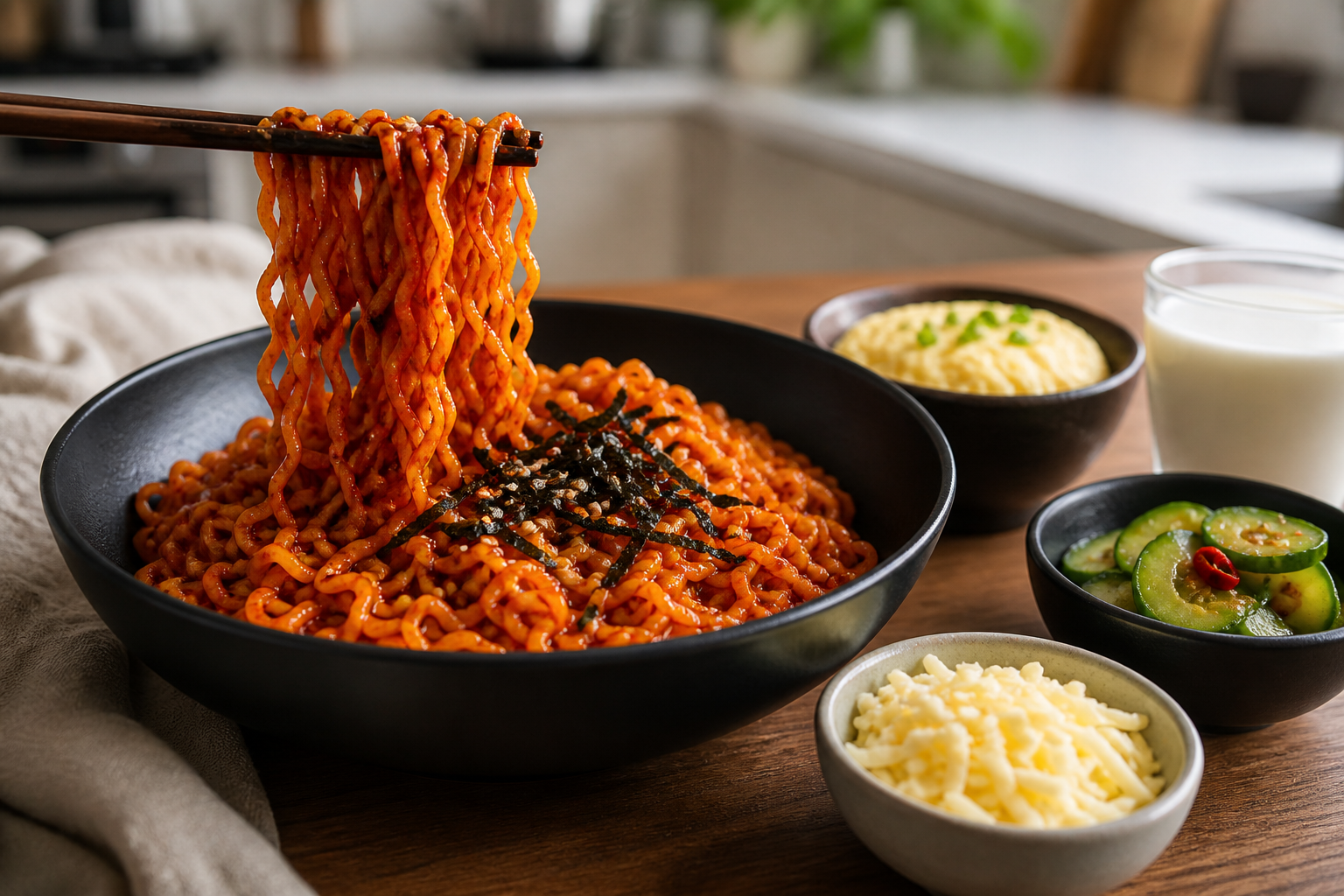
Quick answer: Buldak-bokkeum-myeon is a Korean stir-fried instant noodle known for concentrated heat, chewy noodles and a glossy sauce rather than a bowl of broth. Cook the exact product according to its package, because bag, cup, stew and flavor editions can use different directions.
Buldak has grown far beyond an internet challenge. Samyang Foods reported that more than 8 billion Buldak ramen units had been sold worldwide by March 2025. The best first bowl is about flavor, not proving how much heat you can endure.
Choose your Buldak: a visual flavor and heat guide
Looking for a Buldak carbonara scoville scale? Exact SHU figures circulated online are not confirmed by the current manufacturer pages cited here. This visual guide compares flavor styles, not laboratory measurements; formulations and perceived heat vary.
Carbonara · Pink
Creamy and cheese-led, with plenty of chile heat beneath the milky flavor. A possible first taste with a reduced sauce portion; it is not a mild-noodle guarantee.
4-Cheese · Orange
A richer cheese-focused option for those who like a creamy coating and a lingering kick. Check the exact Quattro Cheese pack and local availability.
Original · Black
The classic glossy stir-fried style: concentrated chile heat with a sweet-savory, chicken-flavored sauce.
2x Spicy · Red
An intensified-heat option. Choose for flavor only if you already enjoy very spicy food; there is no need to finish a bowl as a challenge.
Colored bars are editorial illustrations of flavor positioning, not a calibrated Scoville scale. The supplied 2,600 / 4,400 / 4,400 / 10,000 SHU values have not been verified for current regional packs.
How to cook the standard stir-fried bag
- Bring about 600 ml (20 oz) of water to a full boil.
- Add the noodles and cook for about five minutes, loosening them gently.
- Drain the noodles but reserve 1/2 cup (4 US fl oz, about 120 ml) of cooking water, as specified on Samyang America’s current Original bag page. Other packs may differ.
- Return the noodles and reserved water to the pan, add the sauce, and stir-fry for 30 seconds over moderate heat. For a gentler first bowl, start with less sauce; this also reduces seasoning.
- Turn off the heat, add the sesame-and-seaweed flake packet, and serve while the sauce is glossy.
These are common directions for the standard dry style, not a universal recipe. Stew Type, cup noodles and regional editions may differ. Read the label on the package in your hand, including its allergen statement.
 Original VEMORIQ media
Texture check: the noodles should look evenly coated rather than submerged. If the pan dries before the sauce disperses, add a spoonful of the reserved cooking water; if it looks soupy, stir briefly without overcooking the noodles.
🏪 Han River picnic inspiration: Korean convenience store ramen hacks
Try these convenience-store-style combinations at home or where cooking facilities permit. These are suggested variations, not a verified claim that every Han River store serves the same viral recipe.
1. The Cheese Monster
Prepare one pack of Buldak Carbonara according to its label. Start with less spicy sauce if needed, then mix in a torn mozzarella string cheese and a small scoop of drained sweet canned corn.
Transfer to a microwave-safe bowl and heat in short bursts until the cheese melts, stirring between bursts. About 1 minute may suit some microwaves, but power and portion size vary. Remove wrappers and never microwave a container unless its label permits it.
How to make buldak less spicy: reducing the sauce is the most direct adjustment. Dairy and corn can make each bite feel rounder, but cheese does not completely neutralize the spice. Carbonara and mozzarella contain milk.
2. The K-Ending: triangle kimbap finale
While the noodles and remaining sauce are still freshly cooked, unwrap a samgak kimbap (triangle kimbap), break the rice into the pan and add another torn string cheese. Stir over gentle heat until evenly hot and the cheese has melted; add a small splash of water only if needed.
This gives a spicy mixed-rice finish. For a fried-rice texture, cook briefly in the skillet, watching for sticking. Follow the triangle kimbap’s storage and heating label, and check its fillings for fish, egg, soy or other allergens. Serve promptly.
Preparation reference: Samyang America’s Carbonara directions and allergens. Add-ins are optional editorial serving ideas.
How to make Buldak less spicy
Heat control begins before the sauce goes in: use one-third to one-half of the packet for the first taste, then increase in small amounts. Reducing sauce also reduces the intended salt and sweet-savoriness, so judge the finished bowl before adding anything else. Plain ingredients spread the heat over more food; they do not remove it.
- Add egg: a fried egg, soft-boiled egg or steamed egg makes each bite gentler.
- Add dairy if suitable: a little cheese or milk can soften the impression of heat. Check the package because some flavors already contain milk.
- Add plain food: mix in cooked cabbage, mushrooms, bean sprouts, rice cakes or extra plain noodles.
- Keep a mild side dish: cucumber, pickled radish or plain rice gives you a neutral bite.
- Choose a gentler edition: creamy or cheese-led varieties may taste rounder, although they can still be very hot.
Do not turn eating into a speed challenge. Stop if you feel unwell. Children and anyone with a medical or dietary concern should use extra caution.
Ways to enjoy it
For a simple Korean convenience-store-style meal, top the noodles with egg, sesame seeds and sliced scallion. For a fuller bowl, add cooked vegetables and a small portion of protein. Plain rice can turn leftover sauce into a second texture. Cook meat or seafood fully before mixing it in.
The original dry style emphasizes direct chile heat. Carbonara-style editions add a creamy layer; cheese editions lean richer; stew editions keep broth; and flavor variations may include curry or habanero-lime. Availability and formulations differ by country.
What Korean ramyeon should you try next?
Shin Ramyun
Try this if you want a classic spicy soup instead of a dry, concentrated sauce. It has a savory broth and a different kind of heat from Buldak.
Jin Ramen Mild or Spicy
Jin Ramen Mild is a comfortable next step for someone who wants less fire. The Spicy edition offers a stronger broth while remaining distinct from Buldak’s stir-fried format.
Neoguri
Choose Neoguri for thicker, chewier noodles and a seafood-and-kelp-style broth. Check the ingredient and allergen label if you avoid seafood.
Chapagetti or Chapagetti The Black
This is for a savory Korean instant jjajang-noodle experience rather than chile heat. Chapagetti The Black, introduced in Korea in 2024, uses air-dried noodles according to Nongshim’s official page.
Samyang Ramen
For a link to the company behind Buldak without the same challenge-level identity, try Samyang’s long-running soup ramyeon and compare its softer profile.
Buying and allergy checklist
Choose a sealed product from a reliable retailer and check the best-before date, local preparation language, ingredient list and allergen statement. Samyang America lists wheat, soy and sesame for its current Original bag; creamy and other variants may differ. “Artificial chicken flavor” on a label does not by itself establish whether a particular market’s product suits a vegetarian diet—check the entire label or contact the manufacturer. Halal certification applies to specific packs and markets, not automatically to every Buldak item worldwide.
Sources and update note
Cooking quantities, the 30-second finish and Original-bag allergens were checked against Samyang America’s Buldak Original product page. Variety distinctions were checked against the manufacturer’s product catalogue; global sales context comes from Samyang Foods’ 2024 sustainability report. This is a guide to the cited US-market bag, not a substitute for the current label on your pack.
Community Talk & Local Updates
Visited this place? Share your latest experience with fellow travelers!
The WordPress comment form will appear here. Please keep updates factual, respectful and free of personal medical information.
COOK THE PRODUCT YOU BOUGHT
Buldak is stir-fried ramyeon—not a heat contest
Quick answer: Standard bagged Buldak Original is cooked, mostly drained and briefly stir-fried with sauce; it is not served as a full bowl of broth. Samyang America’s current Original directions specify 20 oz (about 590 ml) water, five minutes of boiling, 4 oz (about 120 ml) reserved water, sauce stirred for 30 seconds and flakes added last. Cup, bowl, stew and regional packs can differ, so the package in your hand overrides this example.
Control sauce before toppings
Cook the noodles fully, reserve the directed water and begin with part of the liquid sauce. Taste after it is evenly mixed. This changes both heat and seasoning, but it is more predictable than adding random toppings before learning the base flavor.
Do not leave a full pot of water
Original is designed as a glossy stir-fried noodle. Too much water turns the sauce thin; too little can make mixing harsh and uneven. Measure the retained water and keep the pan on controlled heat for the package’s final step.
Read format and flavor separately
“Carbonara,” “cheese,” “2X,” “stew type,” bag and cup describe different dimensions. A creamy name does not promise mild heat, and a cup may use different water and cooking directions from a bag.
Stop when your body says stop
Do not force another bite for a video. Pause, move away from the steam and choose a normal side you tolerate. Anyone with a relevant medical condition or previous severe reaction should follow professional medical advice, not a social challenge.
Check the exact regional pack
The current US Original product page lists wheat, soy and sesame, but another flavor or market can differ. Read the package allergen statement every time; cheese- or cream-style names also require checking milk and other ingredients.
Choose by broth and heat
If concentrated dry sauce is not enjoyable, try a clearly labeled mild broth noodle, udon-style cup or gomtang-style white broth. Korean ramyeon is a category, not a ladder where the hottest product is automatically the best.
Four mistakes that ruin the first bowl
- Copying one universal recipe: package format and country edition can change water, time and microwave directions.
- Adding the entire sauce automatically: once mixed, concentrated sauce is difficult to remove.
- Assuming cheese means mild: flavor and heat level are separate decisions.
- Microwaving an unapproved container: use only the method and packaging instructions printed on that product.
A more useful first tasting
- Photograph the front, cooking panel and allergen statement before discarding the wrapper.
- Cook exactly as printed and keep the sauce packet separate until draining is complete.
- Mix part of the sauce evenly, taste a small amount and decide whether to add more.
- Write down the format, flavor and sauce fraction you enjoyed; that is more useful for the next purchase than a color-based ranking.
Questions visitors ask before saving this guide
Is Buldak ramen a soup noodle?
Standard bagged Buldak Original is mostly drained and stir-fried with sauce. Stew, cup and other formats can use different directions, so follow the exact package.
How do I make Buldak less spicy?
The most controllable first step is to mix in only part of the liquid sauce, taste and add more if wanted. This also reduces seasoning intensity, not only heat.
Does Buldak Carbonara mean it is mild?
No. Carbonara describes a flavor style, not a universal heat guarantee. Check the exact product label and begin with a smaller amount of sauce if you are heat-sensitive.
Can I microwave a Buldak cup or bag?
Use only the method printed on the exact package. Bag, cup, bowl and regional products can have different container and microwave instructions.
What allergens are in Buldak Original?
Samyang America currently lists wheat, soy and sesame for its US Original product. Other flavors and markets can differ, so read the allergen statement on your own package.
What Korean ramyeon should I try if Buldak is too hot?
Choose a product explicitly labeled mild or a gentler broth style such as udon or gomtang. Do not assume a pale package or cheese flavor is automatically mild.
Leave a Reply