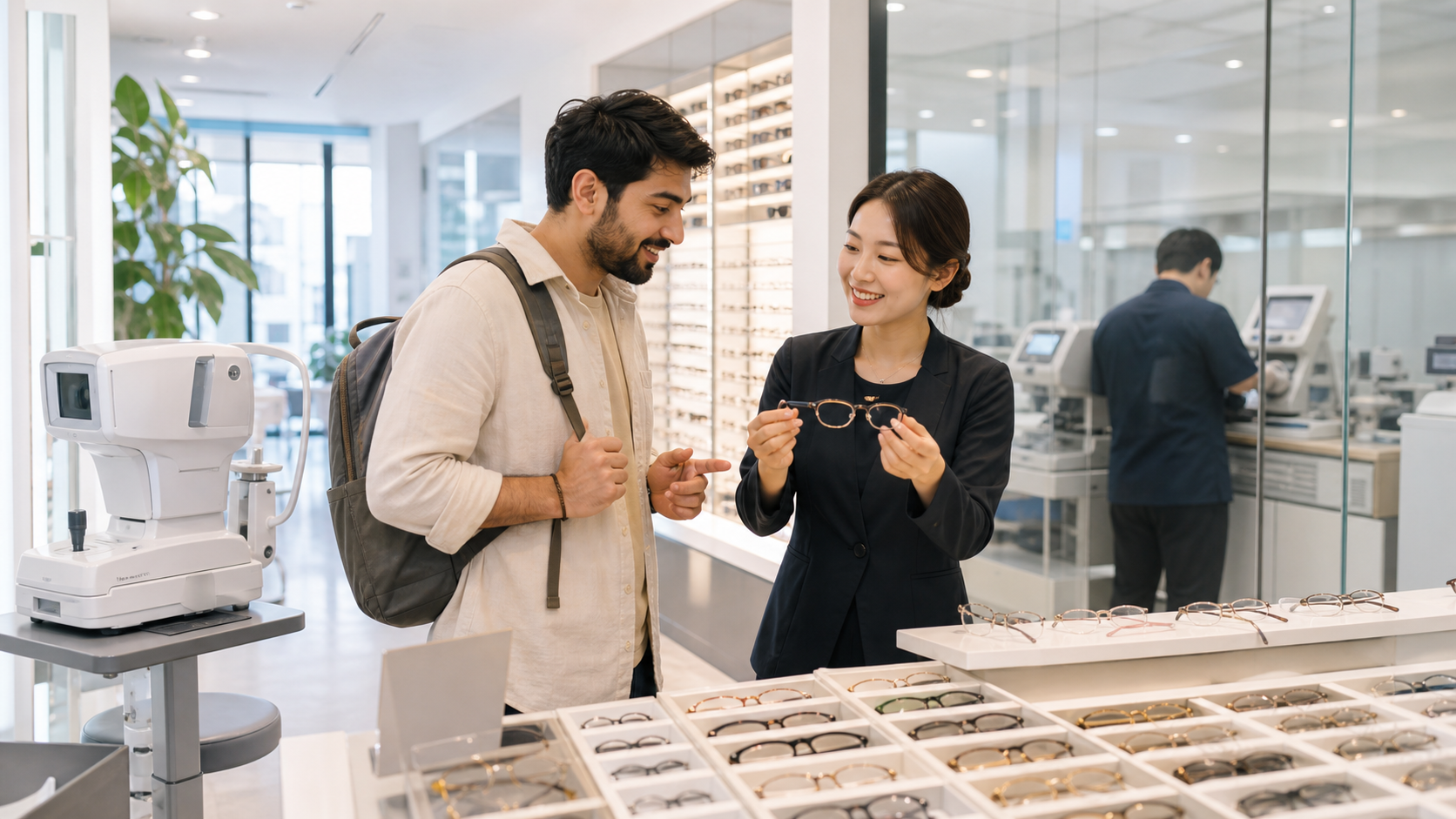
For many international visitors, buying prescription glasses in Korea can be surprisingly simple: measurement, frame selection, lens fitting and final adjustment may all happen in one optical shop. When a common prescription lens is already in stock, some stores can finish a pair within an hour or even faster. Special lenses take longer, so the smartest plan is to visit early in your trip and confirm the schedule before paying.
Quick answer: can tourists get glasses made in Korea?
Yes. Licensed Korean opticians can perform non-drug refraction measurements for the purpose of adjusting eyeglass or contact-lens power, then prepare and sell prescription glasses. A routine single-vision order may be completed the same day when the lens is in stock. Progressive, high-power, prism, specialty coating or custom-order lenses may require several days or longer. An optical-shop measurement is for eyewear fitting; it is not a medical eye-disease examination.
1. Measure
Modern optical shops commonly use an autorefractor and lens-measuring equipment, followed by subjective refinement and fitting measurements. Bring your current glasses or prescription so the optician can compare them with the new result.
2. Choose
Select a frame and lens type in the same visit. The optician can check pupil distance, frame position, lens thickness, material, coating and how the frame sits on your nose and ears.
3. Finish
Many shops have lens edging and adjustment equipment on site or access to a nearby lab. In-stock single-vision lenses can be fast; custom lenses are ordered and fitted after arrival.
The equipment: what each machine actually does
 Original VEMORIQ media
| Equipment | What it does | What the result means |
|---|---|---|
| Autorefractor / keratometer | Uses reflected light to estimate sphere, cylinder and axis; some units also measure corneal curvature. | A fast objective starting point—not the final prescription by itself. |
| Digital phoropter and acuity chart | Presents controlled lens choices while you compare clarity at distance and near. | Subjective refraction refines the prescription according to your answers, comfort and binocular balance. |
| Lensmeter | Reads the power, cylinder, axis, addition and sometimes prism in an existing or newly finished lens. | Lets staff copy or compare old glasses and verify the finished pair against the order. |
| Pupillometer / digital centration system | Measures monocular pupil distance and, for customized lenses, fitting height and frame position. | Correct centration matters especially for progressive, high-power and prism lenses. |
| Slit lamp | Provides a magnified illuminated view of the front structures of the eye. | An eye-health examination tool, not merely a glasses-power test; availability and professional scope differ. |
| Tonometer / retinal imaging | Measures eye pressure or photographs the retina and optic nerve. | Useful clinical information, but a single pressure reading or image cannot diagnose or rule out eye disease. |
Important distinction: a refraction finds the lens power that helps you see clearly. A comprehensive eye examination assesses eye health as well. The National Eye Institute notes that dilation, pressure measurement and examination of the retina and optic nerve are important for detecting diseases that may have no early symptoms. If you have diabetes, glaucoma risk, sudden symptoms or an unexplained change in vision, book an ophthalmology examination rather than relying only on a retail screening.
Lens types: choose by task, prescription and lifestyle
 Original VEMORIQ media
| Lens type | Best suited to | What to confirm before ordering |
|---|---|---|
| Single vision | One correction across the lens for distance, reading or a defined work range. | Working distance, frame size, material and whether both lenses are included in the quote. |
| Office / occupational | Desk, monitor and near work, with a wider intermediate zone than many all-purpose progressives. | Not normally intended for driving or full-distance use; tell staff your actual screen distance. |
| Progressive | Distance, intermediate and near vision without a visible segment line. | Monocular PD, fitting height, corridor design, frame depth, adaptation and remake policy. |
| High-index and aspheric | Stronger prescriptions where reduced thickness and weight are priorities. | Index is not the only factor: frame size, lens shape, centration and prescription also change final thickness. |
| Photochromic | Convenient everyday lenses that darken in response to changing light, especially UV. | Indoor residual tint, activation speed, temperature effects and limited darkening behind some car windshields. |
| Polarized sun lens | Outdoor glare from roads, water and reflective surfaces. | Tint, UV performance, suitability for your displays or instruments, and whether polarization is combined with your prescription. |
| Myopia-control spectacle lens | Selected children with progressive myopia under professional management. | This is a specialty medical-purpose design, not simply a thinner lens; obtain appropriate examination, follow-up and fitting advice. |
Material and coating are separate decisions
- Standard plastic: often economical with good optical clarity, but may be thicker for stronger prescriptions.
- Polycarbonate or Trivex-type materials: commonly considered where lower weight and impact resistance matter; ask about optical properties and local safety certification.
- High-index plastic: bends light more efficiently, allowing less material for the same power, but price, reflections and edge thickness still depend on design and frame choice.
- Hard coat: improves scratch resistance but does not make a lens scratch-proof.
- Anti-reflective coating: reduces surface reflections and can improve appearance and visual comfort, especially at night; compare cleanability, durability and warranty rather than relying only on a “blue-light” label.
- UV protection, tint and mirror coatings: are separate specifications. Request the written lens name, material, index and coating package.
How prescription lenses are made and checked
 Original VEMORIQ media
- Prescription and use are confirmed. Staff check sphere, cylinder, axis, addition and prism, then discuss distance, computer, reading and driving needs.
- The frame is measured on your face. Monocular pupil distance, fitting height and frame position are recorded. Progressive and customized lenses need more measurements than a basic single-vision pair.
- A suitable lens blank is selected. Stock single-vision lenses may be available immediately; progressive, prism, unusual powers and specialized coatings are usually ordered from a laboratory.
- The frame shape is traced and the lens is centered. Blocking equipment positions the optical reference point before the edger cuts and bevels the round blank to the exact frame shape.
- The lens is mounted. Full-rim, semi-rimless and rimless frames require different edge profiles and assembly techniques.
- Final quality control is performed. A lensmeter verifies power, axis, addition and prism; staff inspect coating and surface quality, alignment, screw tension and lens retention.
- The frame is fitted to the wearer. Nose pads, temple angle, level and behind-the-ear fit are adjusted. Recheck the visual result before leaving.
Frame materials and fitting
- Acetate: expressive colors and a substantial feel; heat adjustment should be performed carefully by trained staff.
- Stainless steel or titanium: thin profiles and potentially low weight; verify the actual material, plating and nickel-related concerns rather than judging by appearance.
- Flexible injected plastic: useful for lightness and active wear, but adjustment and lens replacement options vary by construction.
- Rimless and semi-rimless: minimalist and light, but lens material, edge drilling or grooving, and accurate assembly are especially important.
A fashionable frame is not automatically a good optical frame for every prescription. Strong minus lenses usually benefit from a smaller, well-centered shape; strong plus lenses and progressives also need careful size and fitting-height choices. Ask staff to explain why the selected frame works with your prescription before the lenses are cut.
Why Korean optical shops feel different
- One-stop workflow: measurement, frame selection, lens consultation, edging and final fitting are often coordinated in one location.
- Required equipment: Korean rules for optical shops specify equipment such as a visual acuity chart, trial lenses, pupil-distance meter, lensmeter, lens edger or cutting equipment, heater and cleaner.
- Licensed service: the Korean angyeongsa is a licensed optical professional whose legal scope includes preparing and selling corrective glasses and conducting specified non-drug refraction measurements to adjust lens power.
- Large product range: tourist shopping districts often carry many frame shapes, Korean labels, imported options and several lens grades.
- Potential value: prices can be competitive, particularly for locally made frames or standard lenses, but the final cost depends on prescription, lens design, material, coating and brand.
How long does it take?
| Order type | Possible timing | What can change it |
|---|---|---|
| Common single-vision prescription | Sometimes about 15–60 minutes or the same day | Lens stock, queue, frame shape and coating |
| Higher prescription or thinner lens | Same day to several days | Whether the required index and power are stocked |
| Progressive or custom multifocal | Often several days; sometimes about a week or longer | Personal measurements, lens design, manufacturer and remakes |
| Prism, specialty tint or unusual coating | Several days to longer | Custom laboratory production |
These are planning ranges, not guarantees. Ask the shop to write the promised pickup time on your order and leave at least one buffer day before your flight.
What to bring and what to ask
- Your current glasses, most recent prescription and contact-lens details if relevant.
- A list of how you use the glasses: driving, computer work, reading, sports or all-day wear.
- Ask whether the quoted price includes both lenses, coating, thinning, fitting and tax.
- For progressive lenses, confirm corridor design, fitting height, adaptation policy and remake conditions.
- Ask for your measured values, lens specifications, receipt and warranty details in writing.
- Confirm whether staff can explain the process in your preferred language.
When to visit an ophthalmology clinic instead
An optical shop can measure refractive power for glasses, but it does not replace a medical eye examination. Seek an ophthalmologist or emergency care for sudden vision loss, new flashes or many floaters, eye pain, injury, marked redness, double vision, severe headache with visual symptoms, or a rapid unexplained prescription change. Children aged six or younger require a doctor’s prescription for glasses under Korean rules.
Where visitors commonly look
Namdaemun is known for long-established optical shops and broad price ranges. Myeongdong is convenient for multilingual tourist service and long opening hours. Seongsu emphasizes contemporary Korean frame design and showroom-style shopping. These are neighborhood suggestions rather than endorsements; check current hours, language support, lens stock, warranty and tax-refund participation directly with the shop.
Price and tax-refund reality
Korea can offer good value, but “cheaper than abroad” is not universal. Compare the complete specification—not only the frame price—including lens index, progressive design, blue-light or anti-reflective coating, tint and warranty. Tourist tax refunds are available only at participating stores and subject to current eligibility rules; show your passport and keep the receipt.
Official and technical references: VISITKOREA custom-made eyewear guide · Korean law on licensed optician scope · American Optometric Association: comprehensive eye exams · U.S. National Eye Institute: dilated eye exams · ZEISS lens-material overview · U.S. FDA: impact-resistant lenses.
This article is general travel and consumer information, not medical advice or a diagnosis. The featured image is an original VEMORIQ editorial visual with fictional people and an unbranded shop.
Community Talk & Local Updates
Visited this place? Share your latest experience with fellow travelers!
The WordPress comment form will appear here. Please keep updates factual, respectful and free of personal medical information.
Leave a Reply