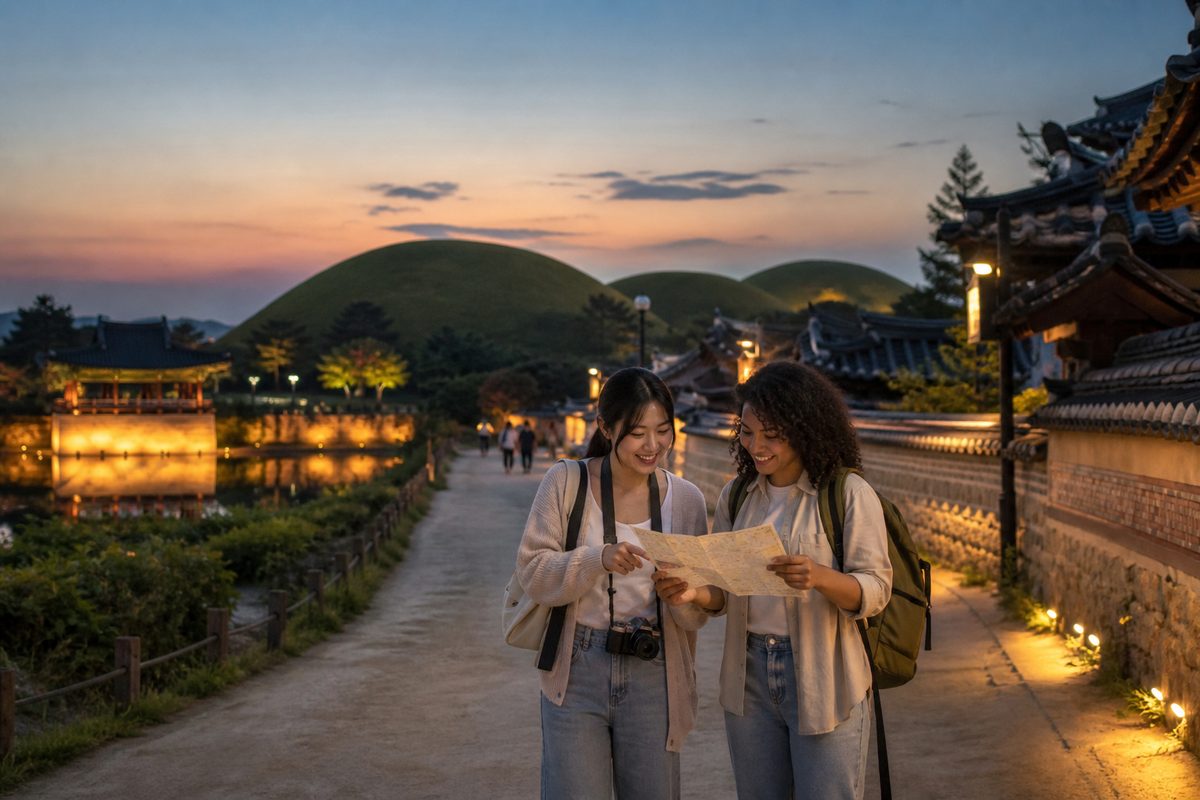
Gyeongju is not one “old town.” Its central tombs and palace remains tell a Silla-capital story; Bulguksa and Seokguram form a separate Buddhist mountain excursion; Yangdong is a living Joseon-era village outside the center. Understanding those layers is the easiest way to build a first visit that has meaning and does not waste the day in transfers.
Read the city in three historical layers
Silla core: Daereungwon’s royal mounds, Cheomseongdae and the Wolseong/Donggung area sit within the historic landscape of the ancient capital. UNESCO groups Gyeongju’s protected historic areas into several belts, not a single walled precinct. Tombs and palace traces are archaeological places, so do not expect every site to look like an intact building.
Mountain Buddhist heritage: Bulguksa’s terraces and pagodas and Seokguram’s granite Buddha are a linked UNESCO property but a separate journey from the downtown walking cluster. See them for stonework, spatial sequence and religious context rather than as a quick add-on between cafés.
Living and later heritage: Gyochon’s hanok setting and the Choi family association are a different layer from the Silla tombs. Yangdong, farther out, preserves a lived-in Joseon village; it should not be described as another Silla ruin or a casual downtown detour. Its residents’ privacy is part of the visit.
Day 1 · walk the central cluster, then stay for light
- Start at Daereungwon: look at the scale and spacing of the tumuli before filling the day with photo stops. Follow marked paths and never climb a mound.
- Move through Cheomseongdae and Gyochon: this stretch rewards a slow walk. Use the observatory and nearby landscape to understand the Silla urban zone, then treat the hanok streets as a later historic setting.
- Cross toward Woljeonggyo: the bridge and river give a different frame from the tomb fields. Photograph from pedestrian-safe positions and avoid blocking the crossing.
- After sunset, choose Donggung and Wolji: reflection and lighting are the draw. Confirm opening and last admission on the visit date; bright night photographs can hide uneven walking surfaces.
Hwangnidan-gil works for a meal or café break, but its modern shops are not evidence that the entire street is an ancient Silla set. Weekends can compress the walking experience; keep one flexible meal stop instead of a chain of timed reservations.
Day 2 · choose one outer route
Option A: Bulguksa, with Seokguram if conditions allow. Start with temple grounds and the stone terraces, then decide whether the additional mountain transfer to Seokguram fits the weather and your energy. The two sites are historically connected but not a single short walk. Check separate opening arrangements and photography rules; interiors and worship spaces deserve particular care.
Option B: Yangdong Folk Village. Choose this if traditional domestic architecture and an inhabited village interest you more than another temple. Korea Tourism Organization lists visitor hours but notes that access can change to protect residents’ privacy and houses cannot be entered without permission. Allow a dedicated half-day and an unhurried return; do not schedule this together with Bulguksa on a short final morning.
Transport and timing decisions
- Your train may arrive at a different station from an intercity bus. Check the exact station name on the ticket and the last local connection to your lodging.
- The compact center is best explored on foot with short breaks. Bulguksa, Seokguram and Yangdong call for a separately planned bus, taxi, car or tour; a straight-line map understates waiting and transfer time.
- If rain makes the walk unpleasant, prioritize one indoor or sheltered cultural stop and preserve the temple excursion for clearer conditions. Do not promise a fixed sunset reflection in any season.
- For photographs, use the rounded tomb forms as a quiet foreground, then let the river or pond carry evening light. Keep tripods and drones within current site rules.
Sources and image transparency
UNESCO: Gyeongju Historic Areas explains the Silla belts; UNESCO: Seokguram and Bulguksa explains the separate Buddhist property; Korea Tourism Organization: Yangdong Village details its lived-in character and visitor conditions. The Gyeongju tourism portal is the place to reconfirm current hours, admission and local routes. The map above is an editorial orientation graphic, not a documentary photo of any individual monument.
Community Talk & Local Updates
Visited this place? Share your latest experience with fellow travelers!
The WordPress comment form will appear here. Please keep updates factual, respectful and free of personal medical information.
Leave a Reply