SEARCH ANSWER · KOREAN FOOD
What is topokki, and is it the same as tteokbokki?
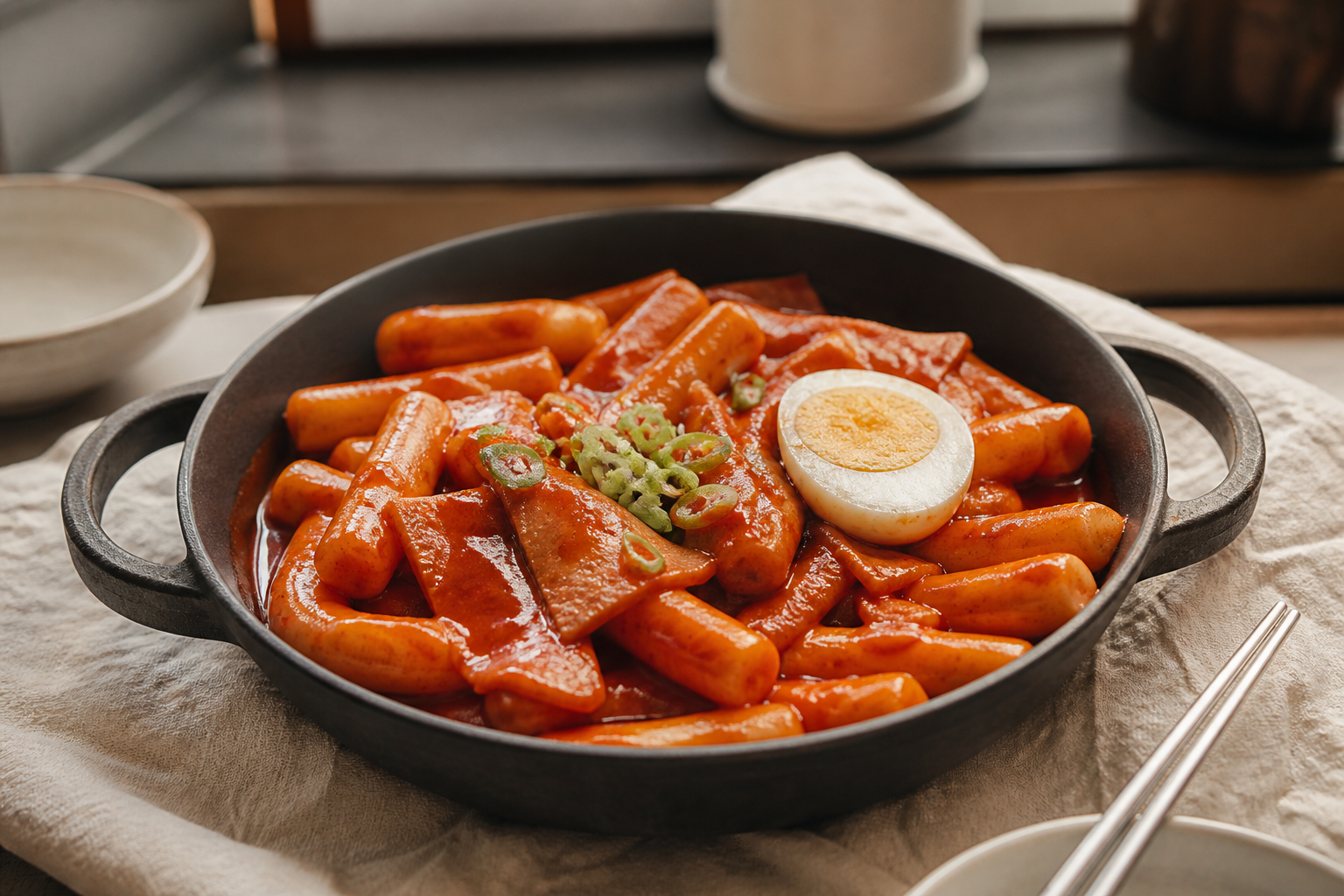
Quick answer: Topokki is a common English spelling for tteokbokki (떡볶이), Korea’s chewy rice cakes cooked in a usually sweet-spicy gochujang sauce. You may also see topoki, toppoki, toppokki or toboki. These usually refer to the same dish, not separate foods. “Tteokbokki” is the spelling most useful on Korean packages and maps.
What are the rice cakes?
For the classic snack-bar texture, buy short cylinder-shaped garaetteok. Refrigerated or frozen cakes may need soaking; follow the package because thickness and starch composition change cooking time.
What does topokki taste like?
The familiar red version balances fermented chili paste, sweetness, salt and a savory stock. Fish cake, cabbage and scallion soften the heat. Cheese or cream makes it milder but changes the traditional flavor.
What should the package say?
Look for 떡볶이떡 or 떡볶이용 떡 on the rice-cake bag and 고추장 on the chili-paste tub. Do not confuse gochujang with gochugaru, the dry red-pepper flakes.
Which version should a first-time cook choose?
- Classic street-food style: red gochujang sauce with rice cakes, fish cake, cabbage and scallion.
- Jeukseok tteokbokki: cooked at the table with more broth and additions such as ramyeon, egg and mandu.
- Gungjung tteokbokki: a non-spicy soy-sauce version commonly served with beef, mushrooms and vegetables.
- Allergy check: fish cake and some sauces can contain fish, wheat or soy; verify every package rather than relying on the dish name.
Official food reference: Korea Tourism Organization describes red tteokbokki as rice cakes cooked with vegetables and gochujang, with fish cake and cheese as common additions. Read the VISITKOREA tteokbokki entry.
 AI-generated editorial illustration
How do you cook Korean topokki at home?
Quick answer: This recipe serves 2–3 using 350 g rice cakes. Prepare the sauce, soften the vegetables, then simmer the rice cakes until tender and the sauce coats them. Allow about 20 minutes of cooking, with timing adjusted to the rice-cake package and texture.
See the complete ingredient quantities · Jump to the detailed method. Use the single recipe below rather than a separate ingredient list.
Five steps at a glance
- Check the rice-cake package and prepare firm or frozen rice cakes as described below.
- Whisk the stock, gochujang, optional gochugaru, sugar and soy sauce in a wide pan.
- Add cabbage and onion; bring to a gentle boil for 3 minutes.
- Add rice cakes and optional fish cake; simmer for 10–15 minutes, stirring often, until tender. Add a splash of water if needed.
- Add scallions and optional eggs in the final 2 minutes, finish with sesame seeds and serve immediately.
 Original VEMORIQ media
FOOD · COOK KOREAN AT HOME
Tteokbokki (also spelled topokki) is Korean rice cakes simmered in a sweet-spicy sauce. The result depends less on adding extra gochujang than on controlling the simmer: the rice cakes release starch as they soften, while the liquid reduces into a sauce that clings to them. Use a wide pan so the cakes heat evenly, stir gently to prevent sticking, and judge doneness by a tender, pleasantly chewy center—not by the clock alone. This version starts with ingredients an international home cook can find and explains how to adjust heat and sauce thickness without losing that texture.
From K-drama scenes to your kitchen
Wondering about the red-sauced snack in small paper cups in Korean street-food scenes? It is tteokbokki, also spelled topokki: a familiar Korean comfort food. If a search for K-drama food topokki brought you here, this Korean street food recipe is a practical place to start. Its vivid red color does not tell you the exact heat level; a balanced homemade sauce combines sweetness, savory stock and chili flavor, with room to adjust the spice.
Prep: 10 minutes · Cook: 20 minutes · Serves: 2–3 · Difficulty: Easy
Why you’ll love it
- One pan and about 30 minutes from start to finish
- Easy to adjust from gently spicy to Seoul snack-bar hot
- Flexible toppings: egg, fish cake, cabbage, cheese or ramyeon
- A practical introduction to gochujang, Korea’s fermented red chili paste
Rice cakes vs wheat cakes for tteokbokki
🌾 Rice Cakes (Ssal-tteok · 쌀떡)
Rice-based cakes usually have a dense, springy, substantial chew. Thick pieces need time to soften through the center and work well with a glossy, concentrated sauce. They are not the same as sweet mochi; buy cakes intended for tteokbokki.
🌾 Wheat Cakes (Mil-tteok · 밀떡)
Wheat-based cakes often have a softer, more elastic bite and are a popular choice for soupy snack-bar-style tteokbokki. They can swell and soften during simmering; check them early rather than assuming they absorb sauce instantly.
Shopping tip: thickness, freshness and flour blends affect both texture and cooking time. Follow the package and taste a piece as it cooks. Wheat cakes contain wheat; rice-based products, gochujang and fish cake may also contain wheat, so check labels if avoiding it.
Ingredients
 Original VEMORIQ media
- 350 g Korean cylinder-shaped rice cakes (tteok)
- 3 cups water, anchovy-kelp stock or mild vegetable stock
- 2 tablespoons gochujang
- 1 tablespoon gochugaru, optional for more heat
- 1½ tablespoons sugar
- 1 teaspoon soy sauce
- 150 g Korean fish cake, sliced, optional
- 1 cup roughly chopped cabbage
- ½ small onion, sliced
- 2 scallions, cut into short lengths
- 2 hard-boiled eggs, optional
- 1 teaspoon toasted sesame seeds, to finish
Before you start
If the rice cakes are frozen or feel very firm, soak them in cool water for 10–20 minutes and drain. Fresh refrigerated rice cakes can usually go straight into the pan. Check the package because cooking time varies by thickness.
How to make tteokbokki (Topokki)
 Original VEMORIQ media
- Build the sauce. Add the stock, gochujang, gochugaru, sugar and soy sauce to a wide pan. Whisk over medium heat until the gochujang dissolves.
- Add the vegetables. Stir in the cabbage and onion. Bring the sauce to a gentle boil for 3 minutes.
- Add the rice cakes. Add the drained tteok and fish cake. Reduce to a lively simmer.
- Stir until glossy. Cook for 10–15 minutes, stirring often so the rice cakes do not stick. The rice cakes should become tender and the sauce should cling to them. Add a splash of water if the sauce thickens before the tteok softens.
- Finish and serve. Add scallions and the optional pre-boiled eggs in the final 2 minutes. Taste the sauce before adding more seasoning: gochujang brands differ in salt and heat. Scatter sesame seeds over the pan and serve while the rice cakes are soft and springy.
💡 Pro-Tips: Is it Too Spicy for You?
How to make tteokbokki less spicy: choose one optional adjustment below. These are variations on the measured recipe, not changes to its ingredient list.
- The Mild Secret: for a new batch, halve the recipe’s gochujang from 2 tablespoons to 1 tablespoon, omit the optional gochugaru, and try 1 tablespoon of tomato ketchup. Ketchup adds sweetness and tang while keeping a red sauce. It does not remove capsaicin, and the result will differ from the classic flavor; taste before adding all the recipe’s sugar.
- The Creamy Twist (Rosé Style): stir in 50 ml (about 3 tablespoons plus 1 teaspoon) of heavy cream or milk during the final 3 minutes of gentle simmering. Cream gives a richer finish; milk makes a lighter sauce. This can soften the perceived heat but will not make a very spicy sauce completely mild. Avoid a hard boil, and note the milk allergen.
- The Umami Booster: anchovy-kelp stock is a common savory base. Use mild vegetable stock or chicken broth instead, keeping the original 3-cup liquid quantity. If using a stock cube, dilute it according to its label and prefer a low-sodium option; salty broth may require less soy sauce. Chicken broth is not vegetarian, and fish cake must also be omitted for a vegetarian version.
For a genuinely non-chili option, try soy-sauce-based gungjung tteokbokki. Add heat gradually: gochujang brands vary.
 Original VEMORIQ media
How to rescue the pan
Test a rice cake, not only the sauce. Cut one of the thickest pieces: the center should be hot and yielding, with no dry, chalky core. The sauce should leave a light coating on the spoon but still move freely when you tilt the pan. These texture cues are more reliable than a fixed minute count.
- Rice cakes are firm but the sauce is thick: add water or unsalted stock a tablespoon or two at a time, cover briefly, then simmer and test again. Do not turn up the heat and scorch the starch.
- Rice cakes are tender but the sauce is thin: remove the lid and simmer gently, stirring across the base of the pan, until the sauce coats the spoon. It will thicken further as it cools.
- Too salty or too hot: loosen with a little water or unsalted stock and taste again. For the next batch, reduce gochugaru first and compare your gochujang label; extra sugar alone does not remove salt or chili heat.
- Rice cakes clump or stick: separate them before adding, use a wide pan and stir from the bottom, especially after the sauce starts to reduce.
Choose your heat level
Mild: Use 1½ tablespoons gochujang, omit gochugaru and add 1 extra teaspoon sugar.
Classic: Follow the recipe as written.
Extra spicy: Add another ½ tablespoon gochugaru. Increase gradually—the heat builds as the sauce reduces.
Easy variations
Cheese tteokbokki: Melt a small handful of mozzarella over the finished pan. VISITKOREA notes that cheese is a popular modern addition.
Rabokki: Add a block of Korean instant noodles with extra water during the final few minutes.
Vegetarian: Use vegetable stock, omit fish cake and check that your gochujang is suitable for your diet.
Non-spicy: Try a soy-sauce-based gungjung tteokbokki instead of the red chili version.
VEMORIQ kitchen notes
- The sauce becomes thicker as it cools, so stop cooking while it is slightly looser than you want.
- Rice cakes are best eaten immediately. For leftovers, divide the food into shallow covered containers and refrigerate at 4°C/40°F or colder within 2 hours of cooking (within 1 hour if exposed to heat above 32°C/90°F). Eat within 3–4 days or freeze sooner. Reheat throughout to 74°C/165°F; use a food thermometer rather than judging by steam alone. For texture, add a splash of water and stir gently over low heat until the rice cakes soften—this is a kitchen technique, not a safety substitute. Discard food left too long at room temperature. FoodSafety.gov: leftover storage and reheating.
- Gochujang brands vary in salt, sweetness and heat. Taste before adding extra soy sauce.
- Fish cake and some sauces may contain fish, wheat or soy. Check packaging for allergens.
What to serve with it
For a Korean snack-bar-style spread, pair tteokbokki with gimbap, fried seaweed rolls, mandu or a light fish-cake soup. The sauce is meant for dipping, sharing and customizing.
No tteok? Try 13 pasta swaps
Rice cakes create tteokbokki’s signature dense, chewy bite, so pasta will not taste or feel exactly the same. But if Korean tteok is unavailable, these shapes can turn the same sweet-spicy flavor idea into a fun tteokbokki-inspired pasta. Use about 200 g dry pasta for 2–3 servings.
 Original VEMORIQ media
The best base method
- Boil the pasta separately, following the package instructions. Stop 1–2 minutes before your preferred doneness.
- Reserve 1 cup of pasta water, then drain.
- In a wide pan, combine 1½ cups water or stock, 1½ tablespoons gochujang, 1 tablespoon sugar, 1 teaspoon soy sauce and 1 teaspoon gochugaru if desired. Simmer for 3 minutes.
- Add cabbage, onion and optional fish cake. Cook for another 3 minutes.
- Add the pasta and toss for 1–2 minutes, loosening with reserved pasta water until the sauce looks glossy and coats the noodles.
- Finish with scallions and sesame seeds. Serve immediately.
Important: Pasta cooking times vary by shape and brand. Follow the package first, taste as you cook and avoid simmering delicate noodles too long in the sauce.
1. Spaghetti — the all-rounder
The easiest place to start. Its familiar medium-thick strands stay firm enough for tossing in spicy sauce. Use the base method exactly as written.
2. Spaghettini (thin spaghetti) — lighter and faster
Thinner than regular spaghetti, it works best with a slightly looser sauce. Transfer it to the pan earlier and finish briefly so the strands do not become soft.
3. Capellini or angel hair — the quick version
Very thin strands absorb sauce quickly. Use only 1 tablespoon gochujang, keep extra pasta water nearby and toss in the sauce for about 30–60 seconds rather than a long simmer.
4. Vermicelli — delicate but satisfying
Italian-style wheat vermicelli sits between very thin capellini and standard spaghetti in thickness. Keep the vegetables finely sliced so they match the delicate noodles.
5. Linguine — chewy flat ribbons
Linguine’s flat surface holds the gochujang sauce well and gives a more substantial bite. It is especially good with cabbage, mushrooms and fish cake.
6. Fettuccine — creamy rose tteokbokki style
Broad fettuccine works beautifully with a milder rose-style sauce. After the gochujang sauce is cooked, lower the heat and stir in ¼ cup milk or unsweetened plant-based cooking cream. Do not boil dairy aggressively.
7. Tagliatelle — rich and saucy
These wide ribbons catch thick sauce and chunky toppings. Use a little extra stock and separate the strands gently when adding them to the pan.
8. Bucatini — sauce inside and out
Bucatini looks like thick spaghetti with a hollow center. Its sturdy bite suits a classic spicy sauce, although it may need more tossing to coat evenly.
9. Penne — easy to eat and share
The short tubes make a convenient party or lunch-box version. Use sliced fish cake and vegetables cut to a similar size so every forkful feels balanced.
10. Rigatoni — bold and extra chewy
Large ridged tubes stand up to a thicker sauce and substantial additions such as mushrooms or sausage. Add a splash of pasta water so the sauce reaches inside the tubes.
11. Fusilli — best for catching sauce
The corkscrew shape traps gochujang sauce in its curves. This is a practical choice for a room-temperature pasta box, but cool it promptly and keep refrigerated until serving.
12. Farfalle — playful and photo-friendly
Bow-tie pasta gives the dish a bright café-style look. The center can stay firmer than the edges, so taste a piece before draining and finish gently in the sauce.
13. Orzo — spoonable comfort bowl
Orzo is small, rice-shaped pasta. Cook it separately and drain well, then fold it into a slightly thinner sauce. Serve in a bowl with egg and scallions for a spoonable, risotto-like variation.
VEMORIQ’s top three picks
- Closest everyday substitute: spaghetti
- Best sauce-catcher: fusilli
- Best for rose-style sauce: fettuccine
Gluten-free option
Rice-, corn- or legume-based pasta can also work, but their textures and cooking times vary widely. Cook according to the package, handle gently and confirm that gochujang, soy sauce and other packaged ingredients meet your dietary needs. This is not a guarantee that the finished dish is allergen-free.
Pasta technique sources: Barilla: How to Cook Pasta · DeLallo: Guide to Pasta Shapes
Try it in Korea: the street-food moment
In Korea, tteokbokki is everyday comfort food as much as a trend. Friends often share it from paper cups at market stalls or small bunsik snack shops, pairing it with fish cake, gimbap and fried snacks. If you visit Seoul, watch for the big shallow pans of red sauce and order a mild portion first if you are unsure about the heat.
 Original VEMORIQ media
About the dish
The Korea Tourism Organization describes tteokbokki as a representative spicy Korean food and one of the country’s most popular street foods. Common versions combine thin rice cakes, cabbage, green onion, gochujang and often fish cake; soy-sauce versions offer a non-spicy alternative.
Celebrity food moment: Charlize Theron cooks in Seoul
During a private visit to Seoul in November 2025, actor Charlize Theron and her daughter joined a Korean cooking class at the studio of Chef Choi Kwang-ho, winner of MasterChef Korea Season 3. Reports and Chef Choi’s social post showed them making tteokbokki and gimbap together. Theron danced after tasting the gimbap, while her daughter responded with a thumbs-up. It is a joyful example of how cooking can turn K-food from something you watch into a memory you make together.
Source note: The original photos and video belong to Chef Choi Kwang-ho and the publishers that licensed or reported them. VEMORIQ links to the coverage rather than copying the copyrighted images.
Name note: Tteokbokki is the official Revised Romanization. Topokki is a simplified brand-style spelling that international menus and packages may also use. “Korean spicy rice cakes” is a clear English description for first-time readers.
Sources and further reading: VISITKOREA: Tteokbokki · VISITKOREA: Jeukseok tteokbokki
This recipe is general culinary information. Ingredient formulas and allergen profiles vary by brand; always read package labels.
Continue your Korean food trip
- Compare fried, soy, spicy and oven-roasted styles in our Korean chicken brand guide.
- Turn a Seoul evening into a fan route with the K-pop and movie locations guide.
- Add a coastal break with the Hyeopjae Beach first-timer guide.
Explore more Korean seasonal food guides
Continue with independently indexable VEMORIQ guides for Korean rice-cake soups, winter street snacks and the complete seasonal collection.
- Tteokguk · Korean rice cake soup
- Tteok-mandu-guk · Rice cake and dumpling soup
- Hotteok · Sweet Korean pancakes
- Bungeoppang · Fish-shaped winter pastry
- Browse all seasonal Korean food guides
Community Talk & Local Updates
Visited this place? Share your latest experience with fellow travelers!
The WordPress comment form will appear here. Please keep updates factual, respectful and free of personal medical information.
Questions visitors ask before saving this guide
Is topokki different from tteokbokki?
No. Topokki, topoki, toppoki and toboki are common phonetic spellings. Tteokbokki is the standard spelling most useful for Korean menus, packages and map searches.
What rice cakes should I buy for topokki?
Choose cylinder-shaped Korean rice cakes labeled tteokbokki-tteok (떡볶이떡). Follow the package for soaking and cooking because fresh, refrigerated and frozen products behave differently.
Can I make tteokbokki less spicy?
Yes. Reduce gochujang and omit gochugaru, then add sweetness or a mild stock gradually. A soy-sauce gungjung tteokbokki is the clearest non-spicy alternative.
Leave a Reply